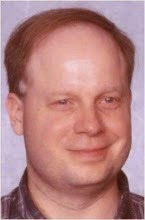


Welcome to Up Around the Corner,
Ryan. Could you tell us a little bit about yourself and your writing?
Thanks, Terry! I’m Ryan,
I’m 31, and I’ve been reading and writing SF in English for a little over half
my life, despite growing up in a small town in continental Europe. A childhood
spent daydreaming about something more than day-to-day life led me to losing
myself in fantasy and science-fiction, and I’ve carried on with that ever
since!
On top of that, I’ve
been playing video games for as long as I can remember, getting exposed to all
the wild imagination that was rife on the Commodore 64 and early PCs. Those two
things combined led me to fall in love with the English language, and that
passion led me to find the words to write down all the stories in my head.

You write more than just novels. What other creative projects are you
involved in?
My ‘day job’ is actually
in independent video games as a writer and designer. Depending on the needs of
the project, I write storylines and dialogue, design whole games from scratch,
and oversee production on team projects. I even do a little bit of voice acting
here and there, like in my upcoming game Euclidean
(website forthcoming) where I perform the voiceovers.
My most recently
released game is FRONTIERS, a large open-world RPG for which I wrote the main
storyline and virtually all dialogue. That’s out on Steam Early Access right
now.
Link: FRONTIERS
Your first published novels would be STREET, your SF cyberpunk trilogy.
Can you tell us about that and how it came about?
Neuromancer was a huge
influence on me when I read it. Most of the science-fiction I’d experienced up
until that point was space opera or high-minded Star Trek-type stuff, which I
still enjoy, but this was something totally new to my experience. I immediately
fell in love with that kind of world, high-tech but earthy. No heroes, no
prophecies, no space battles or world-shaking events. Street-level stories with
street-level people.

Even so, I didn’t do
anything with that feeling for years, until late 2006, when I read Snow
Crash by Neal Stephenson and fell in love with cyberpunk all over
again. Snow Crash’s different take on things convinced me that this wasn’t just
a dead genre from the 80s, that it could be as fresh and amazing now as it ever
was. I wanted to write that kind of story. Cyberpunk that was relevant to the
modern day. I started working on STREET not a week later, and pretty soon
everything else was relegated to the back burner.
I still to this day can’t
believe I finished it. It was a real journey!
Your most recent release is The
Impostor Prince, a fantasy novel co-written with David Debord. Can you
share with us:

a. A little about the novel.
b. How you came to co-author it with David Debord.
c. Any tips or advice for anyone looking to work with a fellow author
on a novel or similar project.
a. The Impostor Prince
is definitely the book I’m most proud of in my career so far. It’s an
action-packed medieval fantasy adventure with a small sprinkling of magic, set
in David’s world of Gameryah, a hundred years after the end of his Absent Gods trilogy. The story centres
around a young career thief called Joren, who kills a man in the heat of the
moment and gets himself involved in events far beyond his station in order to
try to put right what he screwed up. Which turns out to involve impersonating royalty,
romancing princesses, and staying one step ahead of death in the dangerous
halls of political intrigue.
TIP is a standalone story
so you don’t need to have read any of the AG
books. TIP is also slightly grittier than the original trilogy, with
more visceral action and some blow-by-blow swordfights that I’m also quite
proud of, letting me put my background in historical European martial arts to
good use.
b. David and I have
known each other for years, and we’ve always wanted to work on something together.
Since I’ve always been an SFF writer, at first he thought I might be able to
help him finish the third book in the Absent
Gods trilogy, but our writing styles were just too different for me to jump
in mid-series. Then Dave remembered something else he’d started a while ago but
got stuck on twenty or so pages in. A different, standalone book in the Absent Gods setting. He showed me what
he had, and after reading it, I knew it had potential.
c. Communicate! No
matter how you’re doing it or how you’re distributing the effort, always make
sure you’re both working from the same sheet. And if you do end up clashing
over some bit of background or detail, take a step back and really examine the
conflict with a critical eye. Don’t get married to anything just because that’s
how you wrote it.
Can you share with the readers one of the most interesting experiences
you’ve had in your life to date, and what is one thing you hope to do, see or
accomplish within the next decade?
Possibly the most
interesting and amazing thing I’ve done to date is lie in the snow next to a
mountaintop observatory in Greenland, watching the stars in complete darkness
as the Northern Lights closed in on the horizon.
This may sound
absolutely generic, but I’d really like to see my books on store shelves. I’ve
already had a couple of my games turn up in brick and mortar shops and that
felt really nice. I want more of that.
What can readers look forward to from you in the near future with
respect to writing?
I actually have another
fantasy novel completed -- well, the first draft’s completed, anyway. This one
is called Written In Blood, a dark and gritty medieval fantasy, much
darker than The Impostor Prince. I just need a few months to rewrite it! It
should be out in, oh, October or November. After that I’ve got a military
steampunk novel in the works which will be out sometime in 2016.

My next video game, Euclidean, will be out in July-August.
It’s a fun little game of geometric horror, dodging obstacles and monsters
until you can dodge no more. Definitely keep an eye out for that one!
Thank you for taking the time to answer my questions, Ryan.
Not at all, mate, it’s
been a pleasure. Thanks to you and to everyone reading!
To keep up with or learn
more about Ryan and his works, check out the following links:
`


