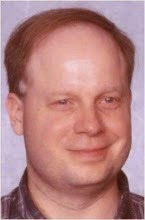


Welcome to Up Around the Corner, Jonathan. Please,
tell us a little about yourself, your interests, and how you became interested
in narrating novels.

Well,
I’m Jon Waters and I’ve always been in the acting gig. Or acting bug as some
might call it. It was just something that I think clicked naturally. Partially
when in kindergarten I dressed as Batman, and then when asked, “What do you
want to be when you grow up?” I came up short. I liked my parents and we
weren’t rich so - Batman was out. Yet looking at everyone else choices of
astronaut, officer, fireman, etc. I stumbled upon, probably from my dad
watching movies while my mom got her degree in the evenings, actors. We’d watch
Star Wars, Jaws, Conan, you know -
kids stuff. And after a while it became clear that 1 - these are all play
pretend. Something I was having a blast at during recess. 2 - these grown-ups
were clearly living very well.
So
I could potentially be a barbarian, hero, firefighter, anything all while
trying to be an actor. Then
I suppose being read to at night by my folks, Calvin and Hobbes, Harry Potter,
Choose your own Adventure. I ate it up.
Then
through college I’d always been interested, and had been doing, little goofy
voices around. Then it dawned that stage and film actors age out. You can’t
play King Lear as a college student and you can’t be Jon Snow as a geriatric.
So time and roles are limited. The limitless, mostly, is Voice Over work. And
yes the voice of a 50 year old will not be the same as a 20 year old, but
there’s a big middle area where you can just live and be. That appealed to me
wanting to, as my dad would put it,

What skills did
you have when you began your career as a narrator? What skills have you picked
up along the way?
So
I was already good in front of an audience, at least the reviews say, but the
training starting all through middle school, to college, to hard knocks
narrating have taught quite a bit.
Breath
work, while overlooked, is a constant. Where to breathe, how to breathe, and
maintain. Theatre and film are a bit of a marathon in their own way. So is narration.
You have to be consistent. You don’t know if someone is going to binge your
work or listen on their half hour commute. So you have to deliver a fine
product every time. Same with theatre and film. Theatre you have a slower
building up and maintain high standards through your performance run. Film, you
maybe get a rehearsal, but you’re expected to have a high energy, recall your
energy because you’re not necessarily filming in order. So scene 4’s energy
might be different from scene 15, but three weeks later you’re back to doing
scene 4 again for whatever reason.
You
also need good communication skills. You’re working with your author and you
need to make sure your lines of dialogue are clean and clear. It can get
muddled, but good authors will be direct and concise with their notes. If
you’re a character reader, like I tend to be, you need to know your buzz/hook
words to get you back to your characters and stress that it’s important that
your author/publisher/rights holder knows what characters are intended to sound
like. There’s nothing worse than narrating what you thought was a male
character and finding out it was actually a female character masquerading all
along. Might not mean much to a more straight reader narrator but, to us
character people, it is a deadly thing to deal with.
I’ve
not quite picked up punch and roll as an editing device. It slows me down. But
I understand the reasoning behind it. I do the click and roll method. Where I
click my tongue, I see it on the file, and go back through and hunt.
Regardless, there may be edits that need to be done when, WHEN, your rights
holder listens to your work. Not necessarily the big ones of “oh this was
actually Jen’s line” or “Where is this whole paragraph” but you might get
things that are small and easily fixed. Examples are “too big of a pause here.”
“repeated lines that didn’t have your click.” I’ve always been of the mind that
two heads are better than one and most times I don’t have a ton of secondary
edits. And if I do, they’re done the day after they are submitted. And you
ensure your author is happy.
Take
care of your voice. Some folks claim to be talkers, I am one of them, and you
might be able to
chat all party long. But you’re needing to hydrate, to take a
breath, let someone else talk, eat. Narration is a marathon. If you don’t warm
up your voice, hydrate, maybe shower beforehand and sing (poorly in my case)
you can potentially damage your voice and make the rest of your day, week,
really rough for your vocal cords. Which may lead to your next project being
pushed back. And in some crazy instances permanent damage. And not everyone
needs a raspy hurt voice for their narrations.

Listen
to podcasts. Levar Burton does a great one to try to learn a new way of reading
books. Pacing, and inflection, and some things you may not have heard before
and want to attempt. Research is everywhere.
What three
individuals would you love to discover have listened to and enjoyed your
work—would make you say, “Now that is totally awesome!”
I’d
assume living yes? Hah! Steven Spielberg - I mean come on. Obviously, right?
Not that I think he’ll give me a job off the bat but - hey who knows. Still the
idea that the guy who filmed Jaws, helped create my first monologue in middle
school (Quint’s Indianapolis speech),
it would be a full circle moment.
Kevin
Conroy - I mean anyone who played the Bat would be a godsend for sure. However,
the guy who, if not my father, really pushed that voice thing home would be
him. “I am vengeance. I am the night. I am Batman.” Ooooh, chills. Every time. And, to that end, to follow that/him
too. That somewhere down the line someone like me could be where Kevin is, and
some kid somewhere follows my suit. “Holy shit! Jon Waters heard my stuff! How
cool is that?”

What things
influence your decision to take on a project and narrate a novel, and what are
some things that cause you or to pass on potential projects?
A
good chunk of it used to be “Will this be fun?” “Is this something that I can
do?” And while the answer is most commonly a “Sure” or “why not?” There is
something to be said these days, since becoming full-time, that makes me go
“Will this pay the bills?”

What
makes me choose on a monetary level is “Can I get this done in a good time, and
can I get a return on my time.” Some books, yes. Luckily I live and work not in
the big three cities of LA, New York, or Chicago. And most cases I’m not
charging Union rates. Which, if I did, it’d become a whole supply and demand
issue where I’m putting out fewer books, but maybe getting one somewhere that
does pay for my month. But what about my royalty share, and throwing more out
there. I think I can luckily say, after nine years doing this that I have both
Quality and Quantity on my side.
Sometimes
you can just tell by the audition script that it’s just not your cup of tea.
Sometimes it’s an author trying to show off with fancy language. And while it
may be a challenge to use all those hard to pronounce words one after another, there
is a simplicity in the ease of reading and description. “Tom went to the store
and he cried, hard, but with the rain falling it was easy to hide.” As opposed
to…say, “Tom, morosely, and with the less than truncated air of a bereaved
partner wept his oceanic eyes to their tumultuous tsunami as he attempted to
parade himself, shivering, through the winter cold to the packed store for
nothing less than a pack of cigarettes.” Better? Yes. Sure. In a literary sense, I hope.
For me I gotta take a big ol’ breath and hope I don’t mess it up because I
gotta attack it again and again until it’s correct.
Many novels have a
variety of characters. How do you determine the voice of each character,
including tone, dialect variations, mannerisms, cadence, among other things to
use when portraying them?
Hopefully
the work gets done for you in preproduction with the author to tell you what
voices they hear in their head. Some authors leave it to us dumb actors to
figure out.
Adjectives
help. Rough, course, light, airy, mousey. How are these characters described as
moving. “Tom clanked with his heavy
armor over to the box.” “Matilda’s lithe form moved like water to the crate.”
You might give Tom a more hardened voice. He’s a veteran. Is he a bad guy, good
guy, hero? Matilda, does her voice reflect that grace? Does she enunciate her
words? Is there a whispery quality to it?
But
accents should be, hopefully, clearly labeled in the book. In the sense that
“Tom was born and raised in Scotland.” Bet he isn’t Russian. But sometimes it’s
never spoken and at that point you and the author can kinda collaborate. For me
it’s always Authors choice first unless they pass it on to me.

Are there any
words or word combinations/phrases that, for some reason, your tongue always
stumbles over and you sort of dread seeing in a novel you’re about to narrate?
Alliteration
always tongue ties me. It shows your authors craft for sure. But it messes me
up something fierce.
And
the big words one right after the other that I, personally, loathe. Because I
do have to look up words, and I’d rather not have to do it 9 times in a
sentence.
But
sometimes a random combination of easy words just throws my tongue and throat
in to a spin. Somedays you just can’t quite get out “Jane went for a walk.”

I
do like to go to the bar. Have a drink. I’m not a beer snob but I do know a
little bit. More of a lager and darker beer fan.
Video
games for sure. I just finished Borderlands
3 and am hopping back into Assassin’s
Creed 3 remastered. I have been spoiled by the newer games for sure.

Love
reading comics. Since I read professionally it’s nice to have pictures with my
literature. Eases my eyeballs.
Especially over a
long project (or even narrating sequels), how do you keep consistent with
character voices, including accents, inflections and pacing? Are there
procedures or techniques you've developed?
I
write down the characters on a notepad by my computer. So that I can
potentially go back and go “Oh, he sounds like….” But sometimes it happens that
it’ll be years between sequels and notepads go missing. So, I have to try to
remember what this side character, who may not have been anything in book 1, is
a huge part in book 2.
But
here again you talk to your author and hopefully if they’re writing to your
narration as well, they can help guide you back on the track.
Accents
and dialects I learned in college but it helps to watch movies. Listen to
people from different places on YouTube.
And try to find those hook words. For my German-accented characters my hook
line is “right, red, road” which should come out as almost “‘ight,’ed,’oad”
with a deep in the throat sound that isn’t present for say, cockney, in place
of the R’s. Etc. etc.
If an editor from
a small press, or a self-published author heard some of your work and was
interested in you narrating a novel, what would be the best route to take?
REACH
OUT! I’m happy to answer any questions or help you out. You can find me on
acx.com, voices.com, findawayvoices.com, YouTube, Twitter, Facebook, and hell,
e-mail: thejonwaters@gmail.com. I’d be happy to help.
I
do have to charge these days, but we can discuss. Even new authors looking for
narrators and what they charge. I’ve been, and am all over the board.
Explain
yourself in your message. I mean, I like a “I LOVE YOUR VOICE” e-mail as much
as the next guy. But if you’re an editor from a small press you probably have
some sort of pitch to get me interested, maybe some things coming up in the
future.
Hell,
ask if I have promo codes for some books. I probably do. “I need to do more
research.” I’d be happy to help.
As we’re closing
in on the end of the interview, Jon, is there anything you’d like to add or say
to the readers here at Up Around the Corner?

But
the big goal of this year is to, at least, do 52 new books. One for each week.
And so far I think I’m doing alright. If nothing else, I’m going to get really
close.


